

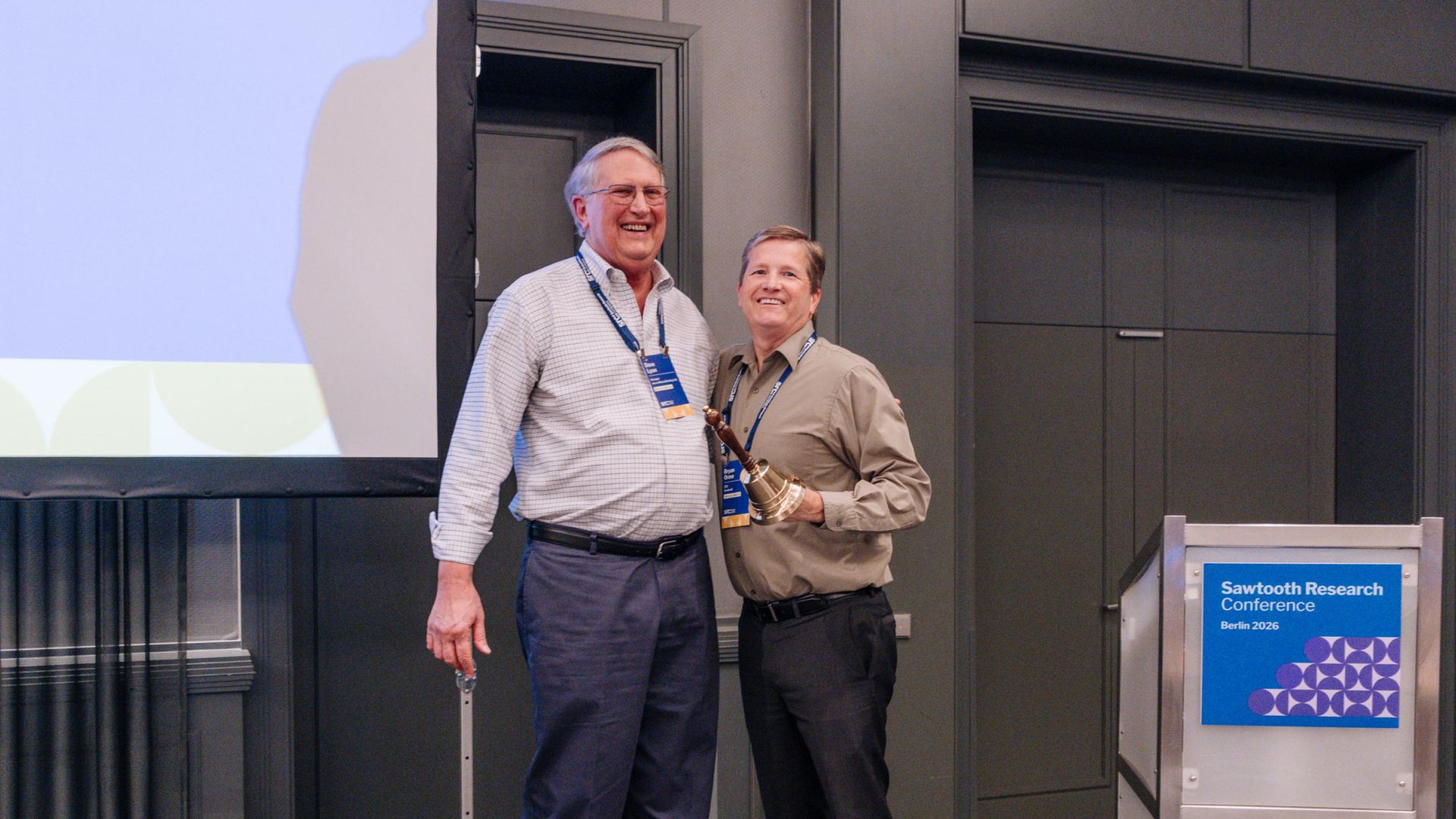
Introduction by Bryan Orme and Acceptance Speech by Dave Lyon
<Bryan speaks> I’m very pleased to be with you here in Berlin at the 2026 Sawtooth Research Conference to present the second 2026 Rich Johnson Legacy Award.
Rich Johnson founded Sawtooth Software in 1983. He created this conference starting in 1987, and we sadly lost Rich Johnson a few years ago. One of Rich Johnson’s enduring traits was his long-time effort to bring thought leadership, education, and training of new and innovative methods of marketing research from academics and practitioners into the applied practice of marketing research.
The Rich Johnson Legacy Award is awarded every two years to an individual who has demonstrated outstanding leadership and a sustained impact over multiple decades toward the advancement of methods used in the field of marketing research practice, especially through Sawtooth events and conferences.
For 2026, we are proud to present the Rich Johnson Legacy Award to David Lyon of Aurora Market Modeling.
<Audience applauds…Bryan coaxes Dave to stand to be recognized and honored.>
Dave wrote most of this next section, so I cannot take credit for the nice touches of humor in it.
Dave Lyon began his market research career with two 6-year stints at full-service market research firms before going independent 30 years ago, specializing in choice modeling and segmentation. Over the years, he has completed about a thousand studies for clients in a wide variety of industries. You might also think he would have done some greater good in all that time—and in fact he has:
- He has taught over 100 tutorials, mostly on pricing research, for the American Marketing Association and others,
- He received the 2003 David K. Hardin Memorial Award for best article in Marketing Research magazine,
- He chaired the 2002 AMA Marketing Research Conference—the largest industry conference at the time—a task he vowed never to repeat, and
- He served on ART (Advanced Research Techniques) Forum Committees and the Marketing Research magazine Editorial Review Board.
Dave has been deeply involved in the Sawtooth community for at least 25 years.
- He has taught many tutorials at Sawtooth Conferences and events,
- He won the “best paper” award at the 2016 conference,
- He’s been a panelist at three Turbo CBC events, including the very first, and
- He has served on the Conference Committee since 2012.
- And he has built a reputation as a thorough and helpful committee reviewer—in other words, a real nitpicker.
In the distant past, Dave played the oboe, hiked the 48 peaks in New Hampshire, and trekked the Himalayas in Bhutan. These days he plays bad golf and mediocre bridge, but he has mastered the art of making fine wines disappear. Throughout, he has been fascinated by the technical nitty-gritty of data analysis and statistics—which is why he refuses to actually retire.
And I will add (and this is my section) that he has been very helpful and supportive of us at Sawtooth Software. The contributions are many, but I’ll mention just a few. He taught us about premium pricing CBC designs rather than using lots of prohibitions. He explicated naïve Bayes classifiers (which we use in MaxDiff typing tools), and most recently helped us with the COA designs for computing Shapley values for huge problems, which he is going to show today. And on a personal note, many years ago, he sat with me for an hour at an airport and patiently helped me understand how Thompson Sampling worked, which helped us make the Bandit MaxDiff breakthrough.
Dave has been a rock on our Conference steering committee for well over a decade, and many presenters have both benefited, yes, perhaps even suffered, from Dave in his role as a paper reviewer. I and many others have looked forward to and admired his wise and thoughtful discussant comments and questions during audience Q&A.
Some of you may remember the 2010 Sawtooth Conference, when Jordan Louviere and Sawtooth were involved in a tense, mano-a-mano bake-off competition involving competing utility estimation methods for CBC. Jordan’s bottom-up experimental design and utility approach vs. standard full-profile CBC designs analyzed via the top-down HB MNL. Jordan had claimed the previous year at the Sawtooth conference that the Sawtooth community was “Sooooooo Wrong” to be estimating preference models with HB, and that academic papers on HB MNL “belonged in the dust bin of failed science.” A split sample validation study done the next year, by Joe Curry and others, showed that Jordan’s claims (on this day) were “less right” (borrowing a line from the movie Megamind). We entrusted Dave with the brave assignment of being the final “So What Have We Learned?” discussant (and the de facto referee) to take the stage and wrap up that remarkable session.
Through it all, Dave has always been generous, thorough, professional, and above all just a fantastically nice individual.
Please join me in congratulating Dave on winning the Rich Johnson Legacy Award for 2026.
<Audience again applauds, and Dave takes the stage>
<Bell rings>. The award is a big bell because the bell is very symbolic of Rich Johnson and the Sawtooth Software Conference. And it is engraved, of course, “Rich Johnson Legacy Award, David W. Lyon, 2026.”
It’s probably not appropriate, but I’m going to give you a hug. <Bryan and Dave hug; Bryan gives Dave the bell.>
<Dave speaks> This is a deeply moving honor.
I want to thank Bryan and Joel Huber, who were the Committee for the Award. Joel is not here this year, possibly for the first time ever. And I want to thank Tom Eagle, who thought up the whole idea of this award in the first place.
It’s only natural to think back to how it all began. I got out of college and worked 12 years first in educational research and testing, and then in agricultural economics and credit. Then, in 1983, I got a job with a full-service market research firm, and that’s when the adventure began.
I was new to the industry, so I would ask my boss, “Who’s our competition? Who are we up against? Who else does what we do?” His answer was always the same: “Oh Dave, nobody does what we do!’”. We were doing conjoint, segmentation, perceptual mapping, Fishbein models… nothing that special.
Later I changed jobs to a company where it was understood that you don’t go to a conference unless you are presenting. In other words, “We have things to brag about, but we don’t have anything to learn.”
Then I got a chance to teach tutorials for the American Marketing Association. I jumped on it. I thought that would be a great marketing ploy, but a couple of my sales colleagues confronted me about it, “Why are you out there giving away the crown jewels and helping other people do things better?”
I felt at times I had gotten into industry full of magicians scared that the audience would figure out their tricks, and fooling themselves as much as anybody else.
But the same year I got into the industry, 1983, was when Rich Johnson founded Sawtooth Software. And, I didn’t know what Bryan was going to say in the introduction, so he stepped on a lot of my lines, but I’m going to ignore that and go there anyway. Rich had a different approach to things.
One of his first products was ACA, Adaptive Conjoint Analysis. It was a totally new, radically different way of doing conjoint. Rich really could have said, “Nobody else does what we do.” I remember looking at the ACA manual and being amazed to find an appendix that laid out, in detail, what it did and how it did it. Anybody who wanted to program ACA for themselves, anybody who wanted to critique it, anybody who wanted to build on it, had everything they needed right in that appendix. Rich believed in openness and transparency, in a big way.
He also believed in actively sharing knowledge. In 1987 he organized and hosted the first Sawtooth Software Conference. The first three Sawtooth Conferences were pretty obviously the motivation for the American Marketing Association to start up the ART Forum series, which ran for 30 years. I have to say that of all the random events and the ongoing forces that have shaped my career, attending lots of conferences was the biggest.
I think I’ve only missed two Sawtooth conferences in 25 years. Tom Eagle and I share the record for most ART Forums attended. Those conferences are where I learned that there are other people doing what we do…often times better. There are people doing things we’ve never even heard of. So, I learned a lot, both in depth and in breadth, and also made a lot of friends.
The most important marketing research conference I ever went to was the very first one. It was the 1988 Sawtooth Software Conference, and Jordan Louviere showed up. He talked about discrete choice experiments, which some of you know as choice-based conjoint. Jordan was energetic, enthusiastic and inspiring, but he did not come equipped with an appendix of details. Even so, I managed to read a lot of his papers, do a little bit of programming, and a year later I was actually doing choice modeling, which became the central skill of my career. So, I owe a lot of what I’ve accomplished to Jordan, and that only happened because of Rich organizing these conferences.
In 2001, Bryan invited me to come to the Sawtooth conference and do a tutorial on pricing research, which I had been doing for the AMA for a few years. So I spruced it up some for the Sawtooth audience, but I kept the part about BPTO, Brand-Price Tradeoff, something that Rich had invented in 1972—pre-Sawtooth—and was very popular. What I had to say about BPTO was not very much: it boiled down to “Here’s what it is; it doesn’t work; don’t do it.” But, here I am at Sawtooth, and who’s sitting in the front row of my tutorial, but Rich Johnson. The good thing is, I didn’t cover BPTO by just giving my opinion. I quoted the exact words of a well-known, widely respected industry expert who had summarized in a few sentences why it didn’t work. That expert was also in the front row, because that expert was also Rich Johnson.
Rich was very willing to try things out and if they didn’t work (and he couldn’t be right all the time), he didn’t get defensive. He didn’t cover up. He just said, “Well, that didn’t work. Let’s see if we learned anything from it.” My reason for covering BPTO was what he had learned from it. So, that went fine. I was still really surprised that Rich showed up to listen to the likes of me, but things went great.
Bryan told you this morning, but I’ll repeat it, what to me is the one sentence that really captures the spirit of Rich on all these issues. That is something Bryan told me years ago. When he first got involved in the Conference, probably in the mid-90s, Rich told him, “If anybody wants to come to our conference and criticize our software, put them at the top of the program.” I think that’s admirable. More than that, and especially at that time, it was courageous. I think it came from real conviction. I don’t think Rich did all these things because they were a good business model…although they were. He just thought they were the right things to do. And, so he did them.
When I think about Rich Johnson’s legacy, there are a lot of nice things you can say about Rich as a person. There are a lot of accomplishments you can point to by Rich as a professional. But I think the most profound and enduring gift that he left us was to have pushed and dragged and led a bunch of secretive sorcerers into becoming a community of professionals who are sharing and spreading knowledge. It’s the exact reason we’re all here today.
So, to have Bryan and Joel, or anyone else, suggest that I might have followed Rich’s path, or maybe tried to extend it, is a deeply moving honor. Thank you.